brt

4MR stormwater project update raises transparency questions

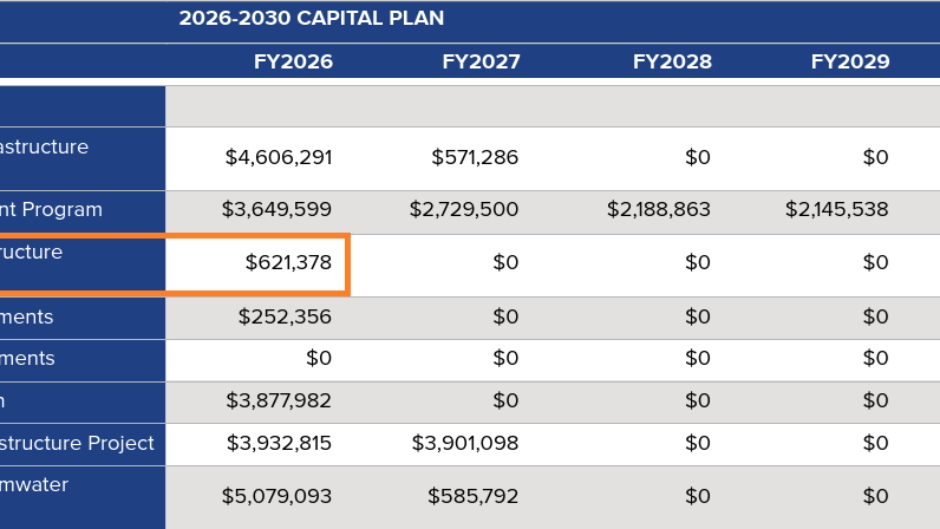
Page 26 of Pittsburgh Water’s 2026-2030 Capital Improvement Plan shows funding given to stormwater projects. The Four Mile Run Stormwater project received $621,378 for data collection from flow monitors. Lines added to highlight relevant information. Pittsburgh Water Capital Improvement Plan - screenshots taken from tinyurl.com/pgh-water-capital-plan

Pittsburgh Water mailed a letter dated Jan. 28 to residents of The Run. It was signed by chief engineering officer Rachael Beam. It assured residents that Pittsburgh Water has not forgotten them. This was Pittsburgh Water’s first formal communication with residents since canceling the project designed to address dangerous flooding in their neighborhood.

The big news: Pittsburgh Water (also known as PWSA) will continue gathering data from flow monitors installed last year. The authority’s 2026-2030 Capital Improvement Plan includes $621,378 for this. The plan is for Pittsburgh Water to update data it collected in 2019. It will then analyze the effects of work like 2022 repairs to the M-29 outfall pipe into the Monongahela River.

The letter made repeated mentions of seeking “alternative” strategies for flood relief. It did not state outright that Pittsburgh Water has abandoned its $8.7 million design for the Four Mile Run stormwater project. But it seems implied.

Watching and waiting

The project billed as a solution to the Run’s longtime flooding received $41 million in 2017. The Mon-Oakland Connector shuttle road planned for the same location was canceled in 2022. After that, Pittsburgh Water removed the green infrastructure part of the plan. Now it would include only “gray” infrastructure—pipes under the neighborhood itself. The authority reaffirmed its commitment to the project, but quietly eliminated funding in late 2024.

Ms. Beam’s Jan. 28 letter cites “limited capital dollars and the need to prioritize regulatory-driven projects” as the reasons for defunding the project.

“While the Four Mile Run project remains on hold, we continue to explore alternatives, engage with partners, and identify potential funding opportunities to move forward responsibly,” she added.

District 5 City Councilor Barb Warwick organized Run residents to speak at a press conference and Pittsburgh Water board meeting last May. She said the utility has kept its promise to update her monthly.

“The people in The Run will not be satisfied until the flooding is fixed,” she told us during a Feb. 15 phone call. “Maybe the M-29 [outfall work] is the fix, but we won’t know that until PWSA gathers the data and shows us.”

Priorities for limited funds

The utility’s Capital Improvement Plan contains a Project Prioritization section. This part explains the process of deciding which projects get funded each year. A committee reviews each new project proposal and scores it based on six criteria: Regulatory compliance, quality of service, safety, risk of failure, security and social impact. Each is weighted differently. For instance, regulatory compliance has the highest at 25%. The committee uses these scores to list top projects for the Pittsburgh Water executive team. The executive team makes funding decisions, then the board votes on the budget.

But scores are missing from descriptions of the projects themselves. This makes it hard to know how some projects won out over others.

For example, the Capital Improvement Plan includes more than $5.17 million for “Bus Rapid Transit Stormwater Infrastructure Improvements.” This amount is spread out over the next four years.

We asked Pittsburgh Water for the scores the Bus Rapid Transit project and the Four Mile Run project received. The authority did not provide them before the print deadline.

A larger pattern

In December, reports by Public Source raised concerns over Pittsburgh Water’s transparency. Community engagement has been limited. For over two years, board approvals have been unanimous with little or no public discussion. Meanwhile, the authority has raised rates and begun collecting a stormwater fee in 2022.

“The stormwater fee they collect does not go to stormwater. It just goes into the general fund — which feels very non-transparent,” Ms. Warwick said.

Pittsburgh Water livestreams board meetings and posts recordings online. But Public Source found that “board deliberation happens privately” in committee meetings or executive sessions. This practice violates Pennsylvania’s Sunshine Act.

Public Source reported that District 8 City Councilor Erika Strassburger said she and her fellow Pittsburgh Water board members “could be better about daylighting some of the hard discussions we have internally … I’ll own that, and we should all own that.”

One of those “hard discussions” may have involved the Four Mile Run stormwater project. Board members never mentioned it in public budget discussions in the months leading up to defunding it.

Attempts at building trust

Ms. Warwick said Pittsburgh Water has consulted with her on how to approach Run residents. The authority wanted to hold another public meeting because they had told residents they would. Ms. Warwick recommended sending the letter instead.

“Until they have results to share with us,” she said of the data monitoring, “I don’t see much point in dragging residents out to a public meeting.”

She praised the Mon Water Project for its advocacy for The Run and the entire watershed. The nonprofit is also advocating for funding to fix Panther Hollow Lake.

“That would be a huge win not just for flood mitigation, but also for preservation of a historic community asset,” she said.

Peer into the depths

View Pittsburgh Water’s 2026-2030 Capital Improvement Plan at tinyurl.com/pgh-water-capital-plan.

Learn more about flood relief projects Mon Water Project has proposed in and around The Run at monwaterproject.org/initiatives/talk-tour-legislative-2025.

Take a deep dive into the history of the stormwater project at junctioncoalition.org/tag/pwsa.

This article originally appeared in The Homepage.

Shuttle Road Slammed at Packed Meeting

Pittsburgh’s Department of Mobility & Infrastructure (DOMI) hoped its October 21 public meeting on the Mon-Oakland Connector (MOC), the first in almost a year, would give citizens one final chance to feel useful arranging deck chairs on the Titanic. But they ran out of deck chairs: The virtual Zoom meeting quickly surpassed its original 100-participant limit and blocked many from joining. After about 20 minutes, meeting organizers solved the problem by expanding capacity to 200 and attendance nearly topped that limit as well.

For the first time, a representative of Almono Limited Partnership (owners of the Hazelwood Green development) was on hand to answer questions from the public. Earlier in the week, Almono unveiled their plan to operate shuttles on the proposed road that uses Schenley Park to connect Hazelwood Green with the universities in Oakland.

Pittsburgh City Council member Corey O’Connor, who represents the affected communities of Hazelwood and Greenfield, was frustrated by the presentation. “We are finally getting answers to some of our questions, which I think is the biggest joke of all time because we’ve been waiting six years for them,” he said.

Councilman O’Connor said the frustration “dates back to the first meeting when we showed up and we had five squiggly lines [representing potential routes for the shuttles] going different ways and we knew we were only going to use one line [the route through Schenley Park] at the beginning, and that was it.”

Alternatives to the MOC plan exist, although the City has failed to give them meaningful consideration.

Our Money. Our Solutions. is a “holistic mobility package” created by residents, community organizations, and others in the affected neighborhoods in cooperation with Pittsburghers for Public Transit. Run resident Barb Warwick said the plan “would provide our communities with faster, more effective, and more affordable bus service to many more locations than just Oakland.”

Richard Feder, an adjunct professor of transportation engineering at the University of Pittsburgh, spoke on behalf the Hazelwood BRT project proposal, which resulted from the 2020 Southwestern Pennsylvania Commission planning study of the State Route 885 and Second Avenue corridor.

“Even worse,” Councilman O’Connor continued, “and this is for my residents in The Run—and I hope this is not true, but the $41 million that we were promised for [the Four Mile Run Stormwater Improvement project] has now turned into 16 million…If it doesn’t stop the flooding problem and protect people, then it’s a bigger farce than it was at the beginning.”

According to PWSA’s own presentation from June 2020, the number is closer to $14 million. In their September 2020 presentation, PWSA tried to cover their tracks by adding costly items they remembered over the summer.     

Councilman O’Connor’s constituents responded in the chat with resounding support of his remarks.

David Caliguiri, the Almono consultant in attendance, characterized the proposed shuttle as “just one part” of “a suite of enhanced transit options.”

Jonah McAllister-Erickson of Pittsburghers for Public Transit responded in a comment, “The constant in the many many iterations [of the MOC plan] has been the shuttle. The idea that this isn’t about the shuttle is laughable. It is and has always been about some sort of shuttle.”

DOMI director Karina Ricks admitted the shuttle component is key because it aims to spur development at Hazelwood Green.

Many MOC opponents expressed concern about the lack of plans in place to protect renters in Hazelwood and Greenfield from the increased housing costs that such large-scale development projects always bring.

Run resident Ziggy Edwards said the City has a long history of deceptive actions related to the MOC project, and that several of her neighbors near the Swinburne Bridge recently received letters from DOMI citing eminent domain.

Ricks responded, “It is a letter written by a lawyer and, unfortunately, they do reference the right of eminent domain. The City has absolutely no intention to take properties [as part of the bridge construction]. There is a possibility there might be some slivers that will be needed to create new footings for the bridge.”   

“She just referred to our neighborhood homes and properties as ‘slivers,’” commented Run resident Justin Macey. “These are our HOMES.”

Hazelwood Initiative director Sonia Tilghman discussed foundation-supported programs in Hazelwood that have allowed her organization to buy 63 occupied units and keep them affordable.

“My concern generally,” said Tilghman, “is that as transportation and access improves to the [Hazelwood] neighborhood—which it absolutely has to—whether that’s through [the MOC project] or through the additional 75 or the 93 [bus lines], we will continue to feel gentrification pressures. And it’s not a fight that we can do alone, so we need additional affordable housing like Gladstone School—we have a partner in that. All of those units will be [for people with incomes] 60% or below AMI [area median income]—it’s not 60-80% where you could find a decent unit without the subsidy. So we’re working on that.”

No organizations or programs exist to provide similar protection to residents in The Run, who would experience the most direct and profound disruptions to their community from the MOC plan.

Earl Danielson commented, “I’ve sat here and listened to a lot of rhetoric … I understand the resistance and the ‘not in my back yard’ mentality of the Run residents but I just wanted to voice my opinion as a property owner in Hazelwood that, properly implemented, the corridor and the connector could be a huge net plus and address many of the issues on the dearth of employment opportunities and shopping and a lot of the other issues that have been hung on Hazelwood since the late ’80s.” 

Hazelwood resident Dylan Rooke responded to Danielson in the chat, “@earl do you live in Hazelwood, or just own 7 investment properties as DANIELSON FAMILY PARTNERSHIP LLLP? gentrification benefits investment property holders against residents, especially renters.”

Moderator Ivette Mongalo-Winston, owner of Mongalo-Winston Consulting LLC, chimed in on the chat, “Please keep this dialogue respectful- re: NIMBY discussion- this is not a personal issue.”

One might wish Mongalo-Winston had been referring to Danielson’s characterization of Run residents as NIMBYs rather than Rooke’s subsequent comment, but this was not the case. Although the comment contained information that reflected poorly on Danielson’s position, it was truthful and entirely relevant. Many MOC opponents went out of their way to display civility.  

Hazelwood resident Eric Williams commented, “@Earl. I disagree with you, but I respect you for representing the other side.”

A record of the meeting is available on the MOC (renamed the Mon-Oakland Mobility Project) website. The partial video begins after the Zoom limit issue had been addressed. Names of foundation and project representatives on the call were not repeated so they are not part of the record. The complete chat transcript includes discussion of the technical difficulties during the first presentation.

Numerous residents, transit advocates, and university students spoke in opposition to the shuttle road. We will devote a separate post to their statements, as well as statements from those who did not get a chance to speak.