Hazelwood Initiative

Hazelwood riverfront rezoning conversation continues: Companies seek trust, residents seek relief

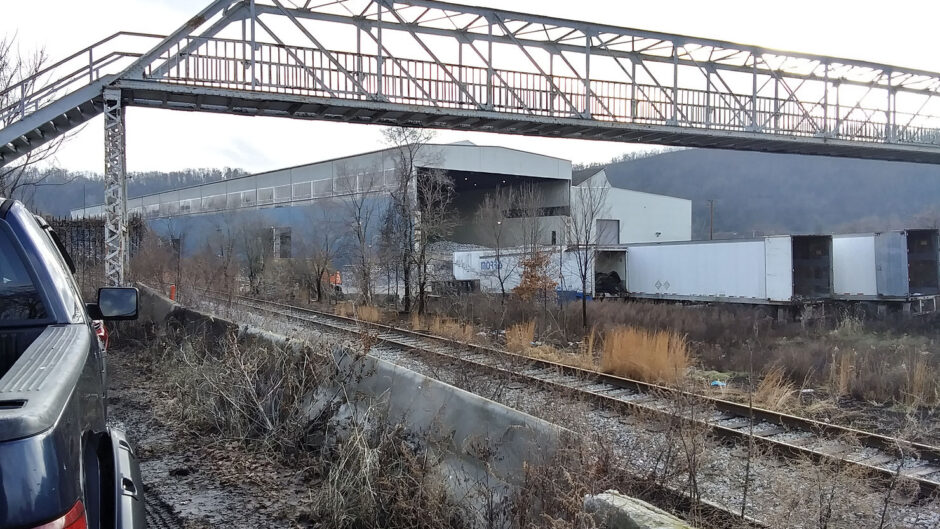
The Republic Services recycling facility in Hazelwood, seen from Dyke Street in January, 2023. Homepage file photo by Juliet Martinez

Pittsburgh’s City Planning Commission voted 4-2 on Nov. 18 to approve rezoning land along Hazelwood’s riverfront. But first, the two dissenting commissioners expressed concerns.

Commissioner Steve Mazza worried the railroads would follow through on threats to sue over the rezoning. Chair LaShawn Burton-Falk said she felt uncomfortable moving forward. She could not be sure there was peace between the industrial facilities and nearby residents.

A rail yard, a recycling facility and a salt depot currently sit on Hazelwood’s riverfront. Since the new zoning designation would not remove them, it would not solve residents’ problems.

“If there’s acute trauma perceived and that acute trauma will not disappear, then what?” Ms. Burton-Falk remarked.

The legislation introduced by District 5 Councilor Barb Warwick will now move to City Council.

Ms. Warwick agreed that building trust is part of the work to be done. She has been in discussions between community groups and facility representatives. She took a tour of Republic Services’ plant. But, she emphasized, “Trust doesn’t protect this community from future harm.”

Life next to heavy industry

Smelly garbage. Rats the size of cats. Dust and lighting so intense that the windows must stay closed even at the height of summer. Loud noise and exhaust from trucks at 4:30 a.m.

More than a dozen Hazelwoodians attended the Nov. 18 Planning Commission meeting. They spoke about these conditions in the neighborhood’s Scotch Bottom section. It lies between the railroad tracks and the Monongahela River.

Scotch Bottom residents said owners of the industrial properties made matters worse by ignoring them.

Catherine Phillips had to seek out a rail yard manager because an employee took to parking his truck by the fence in front of her house. He often left it idling all night. She said she and her neighbors were not told about the salt depot or the recycling plant before those businesses moved in.

“Now they want to bring more trash in,” Ms. Phillips added. She was referring to a pending permit that would allow the recycling plant to also handle waste. “For people who live closer than me, this is a disgrace. This is telling us that we are not worth anything.”

“People need jobs, but you’ve got to have respect for the neighbors,” said her neighbor Bernie Moon. “You took Langhorn Street. Langhorn Street is 400 feet long. There was trees all the way down it. Four years ago, the railroad came in and tore them all down. And what did they do to block the noise? Put a fence up. That’s it. Nobody gets a permit; nobody lets anybody know what they’re doing. They just do what they want to do.”

Tiffany Taulton also lives in Hazelwood. She helped start an air quality monitoring network there when she worked for Hazelwood Initiative Inc. She said on Dec. 10 that she used to walk along Langhorn Street. It was a shady, lower-traffic alternative to Second Avenue. Since the trees were removed, she no longer takes that route.

Ms. Taulton said the environmental organization Local Governments for Sustainability (also known as ICLEI USA) has identified that location as a high-risk area for extreme heat and flooding.

Valerie Testa also lives in Hazelwood. She manages community gardens for Hazelwood Initiative Inc., including one in Scotch Bottom.

“People say, ‘If you don’t like it, move.’ That’s not reality,” she said on Dec. 3. “We shouldn’t have to buy our way into a healthy environment.”

“We don’t tend to [get involved in] legislation, but quite a few residents were interested in air quality,” said Lauren Coursey, Hazelwood Initiative Inc.’s director of sustainability and engagement, on Dec. 9.

She has been hearing from residents about health problems that may come from the heavy industry near their homes.

Improving air quality is listed as a top priority in the Greater Hazelwood Neighborhood Plan adopted in 2019.

The permit that started it all

Republic Services took over the recycling plant at 50 Vespucius St. last February. According to the plant’s general manager, Lori Kolczynski, the permit to handle waste was one of many they set out to transfer from the previous owner. Pennsylvania’s Department of Environmental Protection granted the permit in 2023.

On Nov. 18, Ms. Warwick said the previous owner never informed residents about adding a waste transfer station. Neighbors only found out about the permit when Republic Services applied to have it transferred. But this was not because of outreach by Republic Services. Calls from concerned residents prompted Ms. Warwick to look into the issue. Then she proposed the rezoning legislation.

City rezoning and state permitting processes are separate. The outcome of Republic Services’ permit application may be decided before Ms. Warwick’s legislation is voted on. The state Department of Environmental Protection website lists the waste transfer station permit as pending technical review since June 23, 2025. The target date for a decision is Jan. 14.

Ms. Kolczynski said Republic Services has no immediate plans to add the waste transfer station if it gets the permit. So far, the Phoenix, Arizona-based company has focused on cleanup. In her presentation to the planning commission, Ms. Kolczynski acknowledged numerous neighborhood complaints about the plant under its previous owners.

“Nothing will be brought into this facility without community input and making sure you guys are comfortable with the way that things are being operated,” she said.

Ms. Kolczynski joined the Greater Hazelwood Community Collaborative and said she has been attending meetings.

Open invitations

During a Dec. 11 phone call, Ms. Kolczynski shared details of work Republic Services has done on the plant.

“Cleaning up the interior allowed us to move more material that was being stored outside into the building,” she said.

They enclosed the facility’s glass crusher so less noise escapes. And they boosted rodent control by setting out and maintaining traps more often. She added that because the facility is so close to the river, “It’s going to be an ongoing fight.”

Another improvement was installing doors on two sides of the building. This cut down on wind that blows material and odors off the property.

“I strongly feel this facility doesn’t smell,” Ms. Kolczynski said. The most frustrating part of the Nov. 18 meeting for her was that residents didn’t seem to notice a difference. She invited people to visit the recycling plant and said they had given a lot of tours.

“We want a chance to show who Republic is,” Ms. Kolczynski said of the company’s commitment to fixing what she called “past indiscretions” by previous owners. “We’re asking for the time and opportunity to prove that it’s more than words.”

Ms. Coursey said she recently toured the plant with Hazelwood Initiative Inc. and Ms. Warwick.

“They have enclosed a lot of what used to be wide open. It is a lot cleaner,” Ms. Coursey said. “But in my opinion, that doesn’t change the trucks and the material itself and the noise. I’m not saying anything crazy; that’s just the truth. Heavy industry is not good for a residential neighborhood, especially so close to homes.”

“We can rezone and also talk,” Ms. Coursey added. “We can do both, we will do both. Hazelwood Initiative is always open to talk. Anyone is invited to our community meetings.”

What about Ms. Burton-Falk’s remarks about the need for dialogue between community members and property owners?

“I’m exploring what recourse the city has to remedy complaints about noise, light and rodents,” Ms. Warwick said on Dec. 11. “Once I understand that, I am ready to sit down with the property owners to discuss a community benefits agreement to remedy the damage caused to the neighbors.”

Public can weigh in again

Before City Council discusses and votes on the rezoning legislation, they must hold a public hearing. As of this writing, no date has been set for that hearing. According to Ms. Warwick’s office, it could take place in mid to late January. Keep an eye on upcoming City Council meetings at pittsburghpa.gov/City-Government/City-Council/Clerks-Office/Council-Meeting-Schedule.

This article originally appeared in The Homepage. Photo by Juliet Martinez.
Watershed Advocacy in Hazelwood and Four Mile Run

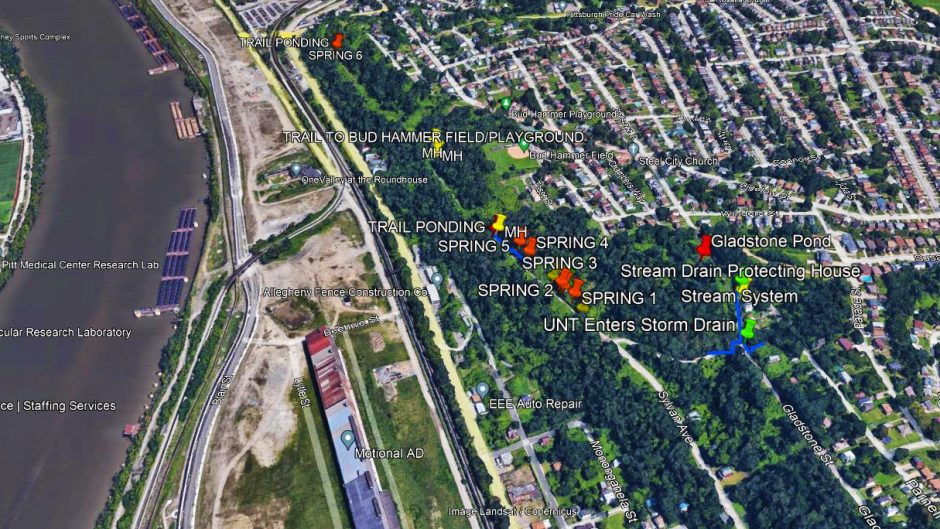
Map of Sylvan Ave. with pins showing streams and ponds

Q&A with Annie Quinn, director of the Mon Water Project

Water issues can mean flooded streets, backed-up sewers, and even landslides. A new organization based in Greenfield has the mission of helping people with all of those. Junction Coalition spoke with Annie Quinn, director of the Mon Water Project (MWP) about water issues in The Run and Hazelwood. Ms. Quinn’s answers have been edited for length and clarity.

JC: Why did you decide to start the Mon Water Project?
AQ: I had been working for four years in watershed science. As I was attending meetings [about the Four Mile Run stormwater project] and hearing PWSA explaining the project to residents, I felt a responsibility. I wanted to help move the conversation forward. The Mon Water Project is an opportunity to serve the community in a way that helps us all with problems around water—and in Pittsburgh, we have a lot of those.

What is watershed science?
The concept of water management within a watershed—how does water move within a system? It’s an area of study that may have been called “freshwater biology” before.

How can the MWP help Hazelwood?
The [water/sewer] lines in Hazelwood are as old as the neighborhood. Hazelwood has been a neighborhood of disinvestment resulting from systemic racism, and the result of the “squeaky wheel” system: More privileged residents in other neighborhoods would call and have their pipes replaced over the years.

I want the MWP to raise voices in Hazelwood, find out about their water issues, and get resources for them. We may not know all the water issues Hazelwood residents face. I see the MWP as a chance to unite us and get good solutions for us all.

What have you done in Hazelwood so far?
Nonprofits often come into a neighborhood thinking they will be the solution to problems. I want to join existing organizations and become the neighborhood’s “Department of Water.” I’ve joined the [Hazelwood Initiative’s] environmental committee. As time goes on, I’m hoping to meet with PWSA and Grounded Strategies and build upon their relationships with residents. I’m also hoping to meet people at events and educational programs. And I would love to get out in the river on a boat so residents can see the outfall into the river. There are a lot of pathways for me to partner with everyone, and I’m looking forward to meeting residents of all the neighborhoods and working with them.

Could water issues affect the planned Sylvan Avenue Trail?
The city is going to have to be careful designing any trail through that area. The number-one issue in trail development is erosion and water damage. There are six streams that are ephemeral—which means they may not be there every day or even every season, but they are a systemic source of water. Any design will have to keep in mind that if not careful about width, ponding, and providing underground transport for water, the trail could become unusable. A pipe could direct water to flow down a steep cliff—and that could eliminate roots on the hillside and contribute to landslides. So for any design, you’d have to know how water works under and around the trail—and where is it safe for the water to go?

What have you learned so far about water issues in The Run?
When PWSA said they’re going back to the drawing board [with the stormwater project], they’re going way back… [PWSA has] a stormwater strategic plan—this is new. Before, they were doing stormwater projects more piecemeal and operating with a different metric… [In the new plan], out of all the watersheds in Pittsburgh, Four Mile Run is ranked 5 out of 19. So the good news is that PWSA plans to keep us in the top five for the city. The bad news is that this pushes the timeline [for fixing flooding in The Run]. It’s possible that Four Mile Run is looking at a delay in the promises PWSA made. The process is looking like several layers of plans, then another design and then a project—which can be very frustrating because the solutions are far in the future. We’ll have to figure out together what we do next.

How do you describe PWSA’s Four Mile Run watershed plan?
I don’t know, and I don’t think the PWSA knows either. That is the problem, and an opportunity for us to push back and get answers on that. It’s important that our next big conversation with PWSA should be answering questions like, how much additional flow will the project capture? What level of storm is that? Have you evaluated what level of service has allowed this type of flooding in the past? What level of service does this project get up to? There is an opportunity through modeling to predict how the system acts before, during, and after the project. At the MWP, we can analyze data. As a nonprofit, we can use PWSA data and study it from different angles to get some good answers and partner with PWSA to get grants. I’m thinking about how we can take our advocacy to the next level.

How does removal of the work in Junction Hollow affect flood control?
The green infrastructure that was proposed in the park…was designed with underdrains so some water goes to groundwater, but a lot is stored and released slowly. [PWSA] said at the [latest] meeting that the new direction [removing the green infrastructure piece] was managing the same amount of water. Slow release would allow them to account for that—the size of the pipes is accounting for holding water back and releasing it slowly… How can we do more storage and slow releasing above ground? How can we avoid feeding a stream into a pipe? The original plan still included water going back into a pipe.

How can the MWP help increase the plan’s effectiveness?
The MWP can be more nimble, flexible, and fluid—like water!— in that we are not a government agency with bureaucracy, with politics. We are a grassroots community organization that can apply for grants the city can’t apply for. Nonprofits often can handle problems quicker, or at least bring a distinct perspective. A unified voice for people throughout the watershed. We’re allowed to dream big and do big, innovative projects.

How can people get involved?
I am a fiscally sponsored nonprofit of another nonprofit—New Sun Rising. My first job is to get a list of leaders to help decide where the MWP goes next. If you are interested, you don’t have to be a professional—just someone in the community who wants to be actively engaged in a leadership role.

Another way to get involved is to sign up for the newsletter to stay up to date as we grow. Right now, that looks quiet. I want to meet the people who are already here.

Visit Monwaterproject.org or email annie@monwaterproject.org for more information.

Notes

About the image: This map shows six springs and ponding along the portion of Sylvan Avenue closed by the city due to landslides. Sylvan Avenue was part of the now-canceled Mon-Oakland Connector shuttle road route between Oakland universities and the Hazelwood Green development. A bike and pedestrian trail has been proposed along the same route. Courtesy of the Mon Water Project

This interview originally appeared in The Homepage.

Hazelwood, Run Residents React to Announced Playground Funding

On Sept. 2, Four Mile Run resident Barb Warwick found Department of Public Works [DPW] workers at the neighborhood’s playground. “[They were] replacing a lot of the old and rusted parts,” she recalled. “My kids are super happy to have their playground back.” 

OnePGH will rehabilitate playgrounds in The Run and Hazelwood 

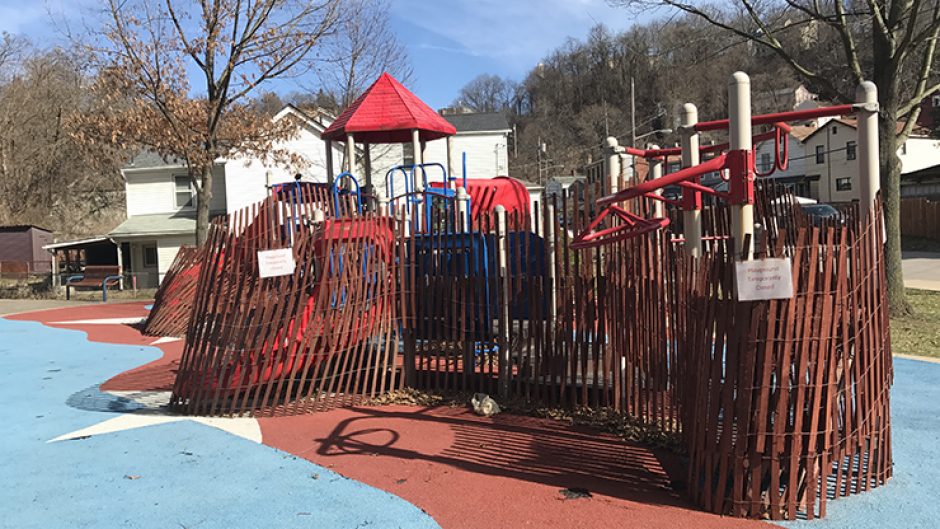
For more than three years, neighbors in The Run had pleaded with city officials to repair and reopen their playground. It was plagued by hazards, including deep holes left by missing benches and tables. Concrete chunks had fallen from the Parkway East during PennDOT repairs, and a broken play structure had injured a child. But the sudden appearance of DPW workers was not quite what the community had asked for. 

A Sept. 3 City of Pittsburgh press release announced that “Carnegie Mellon University [CMU] and the City of Pittsburgh have partnered to provide support for the rehabilitation of Four Mile Run playground in Greenfield and improvements at Lewis playground in Hazelwood as part of the OnePGH community investment plan announced earlier this year by Mayor William Peduto.”

The press release characterized DPW’s work on The Run’s existing playground as “short-term repairs” while the new playground is being planned. But residents of The Run say no one was lobbying for a brand-new playground, and that it should be unnecessary once their playground is fully repaired. 

Plan does not include specifics or reflect neighborhood input

The press release did not say how much CMU planned to donate for each playground. OnePGH is a partnership between the city and outside nonprofits, including CMU. District 5 Councilman Corey O’Connor said there is “no set number” for the CMU donation “because we want to do a neighborhood process to see what people want at both playgrounds.”

“For The Run,” Councilman O’Connor added, “[these current repairs were] City money. We requested the repairs last fall, but there was a backlog due to COVID.”

“It’s exciting to see the work happen,” Run resident Ziggy Edwards said, but added, “We learned about these plans the same way we learned about the CMU- and Pitt-proposed Mon-Oakland Connector [MOC]: through press coverage. It’s disappointing that—once again—major decisions affecting our neighborhood came from a partnership between our elected representatives and monied interests that excluded residents.”

Hazelwood and Run residents, along with dozens of social justice and community groups, churches, and others have rejected the MOC—a proposed shuttle road between the Hazelwood Green development and Oakland campuses championed by the public-private partnership formed between CMU, Pitt, and Mayor Peduto’s administration for that purpose. Residents say building a new road through the Junction Hollow section of Schenley Park and The Run will permanently degrade the park and one day erase the neighborhood. Affected communities including The Run, Panther Hollow, Greenfield, South Oakland, and Hazelwood created their own plan for how MOC funds should be spent instead: Our Money, Our Solutions (OMOS).

The city did not seek input from Hazelwood residents on restoring Lewis Playground 

James Cole of Hazelwood said he was unaware of CMU’s playground funding commitment until contacted for this article. “How is it that no one asked the people in the neighborhoods what they want?” he asked. “I have 150 kids up [at Burgwin Field for youth programs] every day, and this is the first I’m hearing about it.”

Three Rivers Village School [TRVS] is planning a move from the Spartan Center into the former YMCA across Chatsworth Avenue from Lewis Playground. Staffer Jason White-Weidow said he had not heard about the plan to improve the playground either. 

“It would definitely be great for TRVS to have an updated park there and it would get a lot of use by our kids, including the Hazelwood residents,” Mr. White-Weidow said. “We agree though, that it is strange that the community wasn’t consulted.” He added that if other parks or community resource priorities would serve more residents, especially kids, then neighbors’ voices should be heard and respected. 

Councilman O’Connor said the community has expressed itself extensively about both playgrounds. “We’ve heard from people for a number of years,” he said, naming the Greenfield Community Association, Hazelwood Initiative, Inc., Center of Life and other community groups. He said other feedback came from community and budget meetings and 311 calls. 

Councilman O’Connor said there is no timeframe yet for the meetings the city wants to hold with residents, but stressed that “there will be opportunities for community input.”

Residents say Greenfield K-8 needs a playground 

In a similar spirit to the OMOS plan, residents are already identifying and proposing alternatives for the Four Mile Run playground funds. Ms. Warwick says a playground is desperately needed at Greenfield Elementary School. 

“Greenfield is a K-8 school with a special needs program and a Pre-K program. Right now, all they have is a field that’s often too muddy to use and a big parking lot,” Ms. Warwick explained. A group of parents from the Greenfield Community Association and the Greenfield School PTO are working together to raise funds for a playground. “We should build a playground that will improve the lives of kids from all over Greenfield,” she added.