The Run

Our Neighborhoods’ Problems Are “Connectored”

The adjoining communities of Hazelwood and The Run share more than a ZIP code: They are the two neighborhoods most directly affected by the Hazelwood Green development and its most controversial feature, the proposed Mon-Oakland Connector (MOC) shuttle road through Schenley Park.

Hazelwood Green owner Almono Partners commissioned the road, funded with $23 million of Pittsburgh’s capital budget, primarily to link its development to university campuses in Oakland—but says its shuttles will improve mobility for Hazelwood residents. (Almono Partners has voiced no interest in improving anything for Run residents, except perhaps their odds of moving away.)

Getting in and out of Hazelwood can be a major problem, partly because the three streets that serve as entrance/exit points suffer from decades of neglect. The stretch of Irvine Street between Greenfield Avenue and Hazelwood Avenue is a prime example. It contains just about every dangerous condition imaginable for pedestrians, cyclists, and even motorists. A fatal car crash in January 2019 involved frozen seepage from the hill above the east side of the road. This same water helps create year-round hazards on City-owned sidewalks that have disintegrated beside speeding traffic. Vehicles often block other sections of the sidewalk, forcing travelers into the road.   

Only the bravest/most desperate walkers and bikers consider Irvine Street an option—and for people using wheelchairs or pushing strollers, it’s not an option at all. Nor is the long way around through Hazelwood Green accessible to them because it involves navigating steps or crossing Second Avenue.

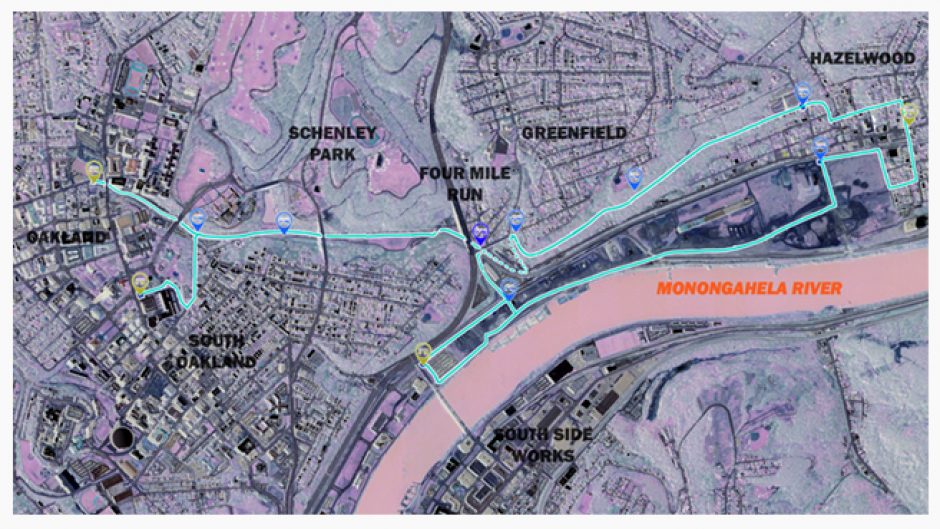
Irvine Street offers the most direct connection between Hazelwood and The Run. The one-mile distance would be easy to cross if not for the serious risks involved. Residents of Hazelwood could safely access Schenley Park without a car. And Run residents would find it much simpler to reach their nearest post office, library, and shops in Hazelwood.

Fixing this dangerous stretch of sidewalk has been identified as a priority by everyone involved. The Greater Hazelwood Neighborhood Plan lists sidewalk construction and improvements as a key strategy to give residents and visitors access to Hazelwood. Our Money. Our Solutions., a community-driven alternative to the MOC, calls for an “Irvine/Second Avenue sidewalk audit and replacement/install to ensure ADA-compliant width and curb cuts, from Greenfield Ave. through the Hazelwood business district.”

Pittsburgh’s Department of Mobility and Infrastructure (DOMI), which is responsible for building the MOC, listed “2nd Avenue sidewalk” as a component of the MOC project in a January 2020 memo to City Council. DOMI committed $700,000 to the sidewalk (to be matched by a potential grant from the state of Pennsylvania). The memo marked the first time DOMI publicly identified certain components (including the sidewalk) as part of the project and broke down costs.

However, in DOMI’s latest budget presented at their October public meetings concerning the MOC, the sidewalk funding has disappeared. It’s unclear whether DOMI will receive the state grant they say they applied for.

Compare the ill-defined, will-o’-the-wisp accounting of the Irvine Street sidewalk funding to the single-minded focus with which the MOC has been pushed over the past five years. Even in the midst of a pandemic that has left Pittsburgh with a $100+ million budget shortfall, the MOC is the city’s single largest transportation corridor investment.

Some say budgets are moral documents. At the very least, Pittsburgh’s budget represents a statement of its priorities. Building a road through a public park for private shuttles in no way reflects the priorities of Pittsburghers, who are being asked to fund this project.

Irvine Street/Second Avenue is only one glaring example of community needs unmet in favor of funding the MOC. As members of these communities, we still have a chance to come together and advocate for the money to go toward improvements we’ve been requesting for years.   

It’s high time for City Controller Michael Lamb to audit the $14.5 million already budgeted to the MOC in 2018 and 2019. Please join us in encouraging him to do so by calling 412-255-2054 or emailing City_Controller@pittsburghpa.gov.

Furthermore, City Council must demand a line-item listing of the additional $4.15 million requested for 2021 to make sure these funds are directed first to fixing existing infrastructure—rather than creating new infrastructure of questionable value to existing communities. Our public money should prioritize solutions to our problems, not developers’ wishes.  
Run Residents to PWSA Board: Create Model for Stormwater Plan Without MOC

On March 27, 2020, the Board of the Pittsburgh Water and Sewer Authority (PWSA) convened its monthly board meeting via telephone conference line. The Board received comments from several residents of The Run, the neighborhood most directly affected by the PWSA’s 4-Mile Run Stormwater Improvement Plan. They asked the Board to create a model for the project that excludes the controversial Mon-Oakland Connector (MOC) road through Schenley Park.

PWSA Chief of Program Management Alex Scuilli has stated on the record that no such models currently exist. MOC opponents have long contended that the MOC—a development project designed to lure corporations to Hazelwood Green—should not take precedence over the stormwater project, which addresses severe flooding in The Run as well as an EPA mandate to separate stormwater from sewage.

Despite its importance to public safety, the stormwater project is not expected to fix the flooding but only lessen it. Right-to-Know documents show Pittsburgh mayor Bill Peduto’s chief of staff Dan Gilman admonishing the PWSA to “improve the messaging on this issue” to adjust residents’ expectations. The vast majority of runoff that floods The Run comes from Greenfield—not Schenley Park, where funding for the stormwater project has been directed. Yet the project was originally pitched to residents as a way to address the flooding issue. The “messaging” changed in early 2019—well into the engineering process. The core project in Schenley Park has long been considered “technically challenging” even without incorporating a new road.

It seems likely the $41 million stormwater project could be more effective if it weren’t required to accommodate the MOC. Multiple experts have told residents of affected neighborhoods that the MOC could hinder flood control. Recently, Pittsburghers for Public Transit worked with analysts to complete a cost-benefit study of expanded public transit versus MOC shuttles in affected neighborhoods—but some costs of the MOC fall outside the scope of that study, including harm to the stormwater project’s effectiveness and to Schenley Park itself. These costs must be examined at least as carefully as the costs of inefficient shuttle service.

There is a clear public need for the PWSA’s stormwater project, and a clear lack of need for the MOC. The MOC benefits developers, not residents, and exemplifies the “non-essential construction” Governor Wolf has halted during the COVID-19 crisis. It is more prudent than ever to develop alternative plans.

Contact the PWSA

412-255-2423
www.pgh2o.com/report-an-issue

Pre-election Letter to Allegheny County DA Candidates

Dear Ms. Middleman/Dear Mr. Zappala,

We are writing to make you aware of an issue affecting our communities of Four Mile Run (The Run) and Panther Hollow, which border each end of the Junction Hollow portion of Pittsburgh’s Schenley Park. All are in danger of being erased by corrupt development practices of city government and its private partners.

In 2015, Mayor Peduto’s office and the Urban Redevelopment Authority (URA) announced a plan to build a publicly financed, privately controlled roadway through both neighborhoods and Schenley Park. This plan, then called the Oakland Transit Connector, is now known as the Mon-Oakland Connector or the Mon-Oakland Mobility Project. We were never consulted about the plan before it was announced—a violation of Pennsylvania’s Sunshine Act.

We learned of the Mon-Oakland Connector from an article in the Pittsburgh Post-Gazette that reported, “The URA this month approved a $3 million application for a state grant to help pay for the first phase of the project…” The grant application, filed with the Pennsylvania Department of Community and Economic Development (Single Application ID: 201507311048; Web Application ID: 8068967), contained numerous falsehoods as detailed in a letter from a concerned Panther Hollow resident. A section of the grant application states:

The act of knowingly making a false statement or overvaluing a security to obtain a grant and/or loan from the Commonwealth of Pennsylvania may be subject to criminal prosecution.

After residents filed Right-to-Know (RTK) requests with the URA, the URA turned over their grant application but with several missing pages. Our neighbor had already received the full grant application from Harrisburg. Details about material redacted from the grant application can be found at www.opnnews.org/2016/03/ura-files-suspect-development-grant-without-consulting-residents.

For more than four years now city officials, consultants, and private partners have misled and outright lied to residents, the public, and the press regarding the Mon-Oakland Connector. Through additional RTK requests, we have obtained proof of their deceit.

We want to know where you stand on this issue. The District Attorney of Allegheny County has a duty to investigate corruption on the part of public officials. If you win the office in our upcoming election, will you investigate the PA Sunshine Act violation, the fraudulent grant application that was unlawfully redacted in response to a RTK request, and other evidence of corruption?

We look forward to your prompt response. It will determine whether we and our supporters cast our votes for you on November 5th.

Sincerely,

Junction Coalition

junctioncoalition@gmail.com

junctioncoalition.org


This Is Our Flooding Problem

Since last year, the PWSA has had $41 million in funding to fix an urgent public safety issue in the heart of Pittsburgh. Please call 412-255-2423 to ask them, “What’s the holdup?”

As you watch the video above, imagine that Four Mile Run is your neighborhood. In a way, it is.

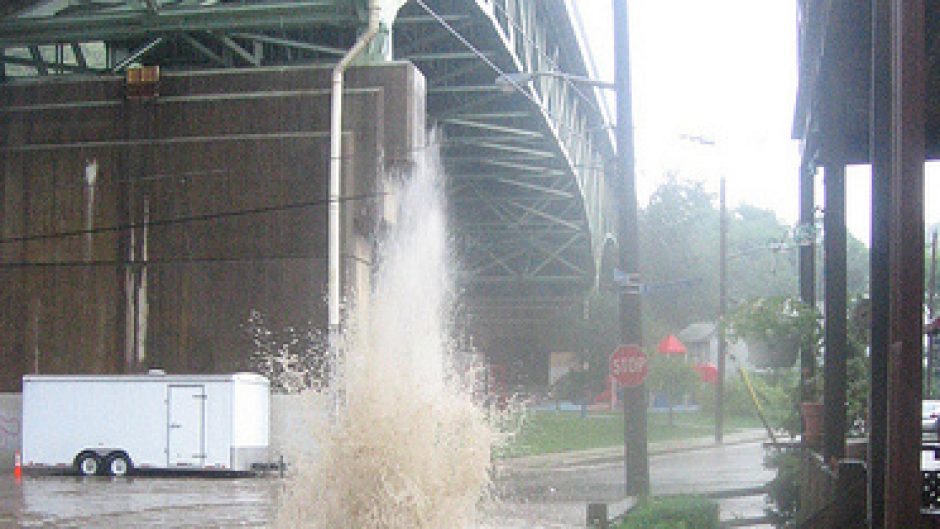
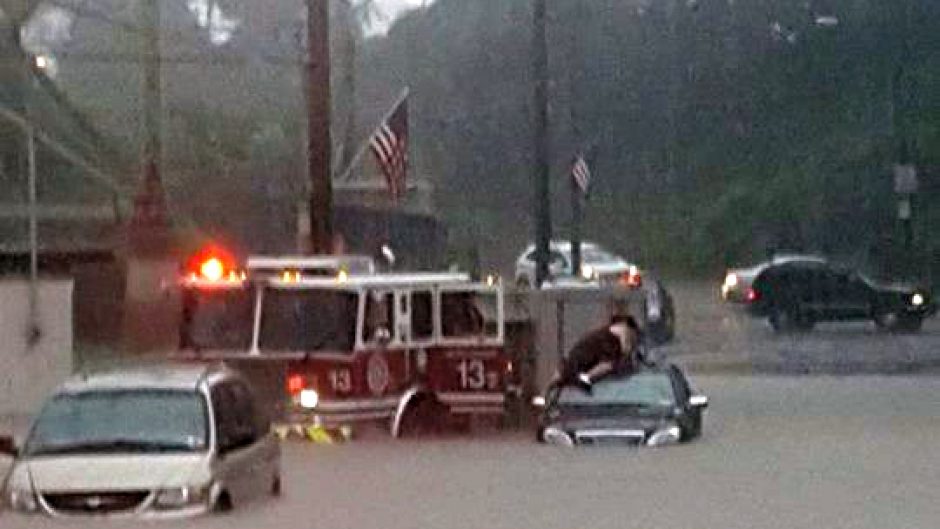
Those of us who live here see “The Run” as unique, but it has the basics that most neighborhoods share: houses, sidewalks churches, businesses—and a community of people. Imagine these are your streets and homes filling with water, your neighbors becoming trapped on top of their car, your children at risk of drowning.

They are.

If you live in Pittsburgh, you’ve likely traveled over The Run on the Parkway East. You may frequent or live in the better-known neighborhoods above us that get this water first—and more and more of this water ends up in The Run as unchecked development covers acres of land with impervious surfaces like asphalt.

As the flooding steadily worsened over decades, your neighbors were told time and time again that our city lacked funds to fix it. So it was a big deal when PWSA secured the $41 million earmarked for the problem. Now, even with funding finally in place, more than a year has passed and work has not started on this important and necessary project.

Why so much foot-dragging? Unfortunately, there is more to the story—and the details are dirtier than the sewage in our basements.

Please call the PWSA at 412-255-2423 to demand they fix this urgent public safety issue using green solutions.