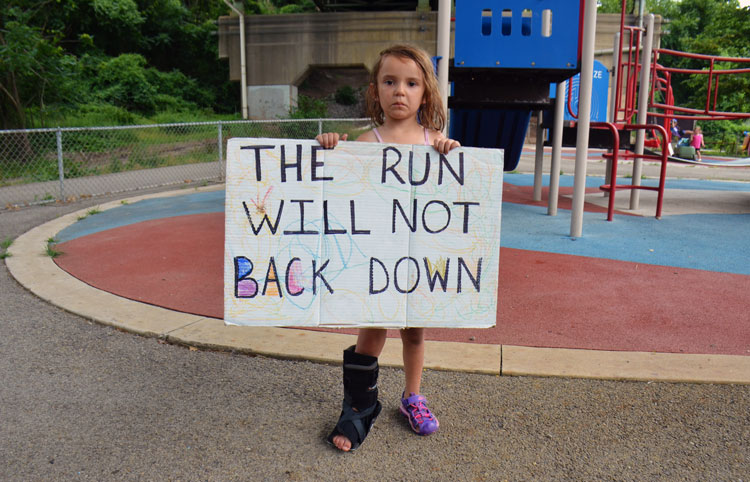
Flooding

Shuttle Road Slammed at Packed Meeting

Pittsburgh’s Department of Mobility & Infrastructure (DOMI) hoped its October 21 public meeting on the Mon-Oakland Connector (MOC), the first in almost a year, would give citizens one final chance to feel useful arranging deck chairs on the Titanic. But they ran out of deck chairs: The virtual Zoom meeting quickly surpassed its original 100-participant limit and blocked many from joining. After about 20 minutes, meeting organizers solved the problem by expanding capacity to 200 and attendance nearly topped that limit as well.

For the first time, a representative of Almono Limited Partnership (owners of the Hazelwood Green development) was on hand to answer questions from the public. Earlier in the week, Almono unveiled their plan to operate shuttles on the proposed road that uses Schenley Park to connect Hazelwood Green with the universities in Oakland.

Pittsburgh City Council member Corey O’Connor, who represents the affected communities of Hazelwood and Greenfield, was frustrated by the presentation. “We are finally getting answers to some of our questions, which I think is the biggest joke of all time because we’ve been waiting six years for them,” he said.

Councilman O’Connor said the frustration “dates back to the first meeting when we showed up and we had five squiggly lines [representing potential routes for the shuttles] going different ways and we knew we were only going to use one line [the route through Schenley Park] at the beginning, and that was it.”

Alternatives to the MOC plan exist, although the City has failed to give them meaningful consideration.

Our Money. Our Solutions. is a “holistic mobility package” created by residents, community organizations, and others in the affected neighborhoods in cooperation with Pittsburghers for Public Transit. Run resident Barb Warwick said the plan “would provide our communities with faster, more effective, and more affordable bus service to many more locations than just Oakland.”

Richard Feder, an adjunct professor of transportation engineering at the University of Pittsburgh, spoke on behalf the Hazelwood BRT project proposal, which resulted from the 2020 Southwestern Pennsylvania Commission planning study of the State Route 885 and Second Avenue corridor.

“Even worse,” Councilman O’Connor continued, “and this is for my residents in The Run—and I hope this is not true, but the $41 million that we were promised for [the Four Mile Run Stormwater Improvement project] has now turned into 16 million…If it doesn’t stop the flooding problem and protect people, then it’s a bigger farce than it was at the beginning.”

According to PWSA’s own presentation from June 2020, the number is closer to $14 million. In their September 2020 presentation, PWSA tried to cover their tracks by adding costly items they remembered over the summer.     

Councilman O’Connor’s constituents responded in the chat with resounding support of his remarks.

David Caliguiri, the Almono consultant in attendance, characterized the proposed shuttle as “just one part” of “a suite of enhanced transit options.”

Jonah McAllister-Erickson of Pittsburghers for Public Transit responded in a comment, “The constant in the many many iterations [of the MOC plan] has been the shuttle. The idea that this isn’t about the shuttle is laughable. It is and has always been about some sort of shuttle.”

DOMI director Karina Ricks admitted the shuttle component is key because it aims to spur development at Hazelwood Green.

Many MOC opponents expressed concern about the lack of plans in place to protect renters in Hazelwood and Greenfield from the increased housing costs that such large-scale development projects always bring.

Run resident Ziggy Edwards said the City has a long history of deceptive actions related to the MOC project, and that several of her neighbors near the Swinburne Bridge recently received letters from DOMI citing eminent domain.

Ricks responded, “It is a letter written by a lawyer and, unfortunately, they do reference the right of eminent domain. The City has absolutely no intention to take properties [as part of the bridge construction]. There is a possibility there might be some slivers that will be needed to create new footings for the bridge.”   

“She just referred to our neighborhood homes and properties as ‘slivers,’” commented Run resident Justin Macey. “These are our HOMES.”

Hazelwood Initiative director Sonia Tilghman discussed foundation-supported programs in Hazelwood that have allowed her organization to buy 63 occupied units and keep them affordable.

“My concern generally,” said Tilghman, “is that as transportation and access improves to the [Hazelwood] neighborhood—which it absolutely has to—whether that’s through [the MOC project] or through the additional 75 or the 93 [bus lines], we will continue to feel gentrification pressures. And it’s not a fight that we can do alone, so we need additional affordable housing like Gladstone School—we have a partner in that. All of those units will be [for people with incomes] 60% or below AMI [area median income]—it’s not 60-80% where you could find a decent unit without the subsidy. So we’re working on that.”

No organizations or programs exist to provide similar protection to residents in The Run, who would experience the most direct and profound disruptions to their community from the MOC plan.

Earl Danielson commented, “I’ve sat here and listened to a lot of rhetoric … I understand the resistance and the ‘not in my back yard’ mentality of the Run residents but I just wanted to voice my opinion as a property owner in Hazelwood that, properly implemented, the corridor and the connector could be a huge net plus and address many of the issues on the dearth of employment opportunities and shopping and a lot of the other issues that have been hung on Hazelwood since the late ’80s.” 

Hazelwood resident Dylan Rooke responded to Danielson in the chat, “@earl do you live in Hazelwood, or just own 7 investment properties as DANIELSON FAMILY PARTNERSHIP LLLP? gentrification benefits investment property holders against residents, especially renters.”

Moderator Ivette Mongalo-Winston, owner of Mongalo-Winston Consulting LLC, chimed in on the chat, “Please keep this dialogue respectful- re: NIMBY discussion- this is not a personal issue.”

One might wish Mongalo-Winston had been referring to Danielson’s characterization of Run residents as NIMBYs rather than Rooke’s subsequent comment, but this was not the case. Although the comment contained information that reflected poorly on Danielson’s position, it was truthful and entirely relevant. Many MOC opponents went out of their way to display civility.  

Hazelwood resident Eric Williams commented, “@Earl. I disagree with you, but I respect you for representing the other side.”

A record of the meeting is available on the MOC (renamed the Mon-Oakland Mobility Project) website. The partial video begins after the Zoom limit issue had been addressed. Names of foundation and project representatives on the call were not repeated so they are not part of the record. The complete chat transcript includes discussion of the technical difficulties during the first presentation.

Numerous residents, transit advocates, and university students spoke in opposition to the shuttle road. We will devote a separate post to their statements, as well as statements from those who did not get a chance to speak.

Who Is Bending PWSA Backward to Accommodate the Mon-Oakland Connector?

The answer may not surprise you

Per usual, a number of disturbing revelations floated to the surface at PWSA’s September 15 public meeting about the Four Mile Run Stormwater Improvement project. Highlights include:

  • The plan calls for removing 900 trees from the Junction Hollow/Panther Hollow section of Schenley Park, according to Tim Nuttle of Civil & Environmental Consultants (CEC). Most of the trees slated for removal, Mr. Nuttle said, are located at the north end of Schenley Park in the Panther Hollow neighborhood. Presumably, this total does not include trees that would be cut down by the controversial Mon-Oakland Connector (MOC) road through Schenley Park.
  • Part of the project attempts to address the large amounts of runoff from the Parkway East overpass that cuts through The Run, but despite talks between PWSA and PennDOT there is currently no plan for PennDOT to share any of the costs.
  • The MOC and the foot path have both been moved since the previous PWSA meeting on June 18 of this year. PWSA representatives said they heard that people didn’t want the walking trail right next to the MOC, which is designed to accommodate motorized shuttles between Hazelwood Green and the university campuses in Oakland. The foot path, in the latest PWSA presentation, has been moved to the other side of the soccer field. The MOC has also changed course, but in the presentation a photo covered a critical turn in its path. Before reaching the southern entrance to Schenley Park, where they diverge at the soccer field, the two paths are still side by side. Twitter user @Bram_R recalled, “When [residents] asked about the safety of that, were told there’d be ‘a piece of wood or something’ separating [the MOC and foot path].”
  • PWSA has spent months telling concerned residents that no model of the Four Mile Run Stormwater Improvement project exists that excludes the MOC. But during this most recent meeting, PWSA representatives divulged that such a model does exist. According to this new narrative, the MOC was added to the stormwater models after initial public meetings where residents expressed concerns about how a new asphalt road (and associated removal of trees) would affect the project’s ability to address the flooding issue in The Run.

    MOC opponents contend that the MOC—a development project designed to lure corporations to Hazelwood Green—should not take precedence over the stormwater project. The core project in Schenley Park has long been considered “technically challenging” even without incorporating a new road.

    PWSA continues to withhold the MOC-free model from residents, and did not use it in their chart where they showed a net benefit in flood control. The presentation implied that this positive result is because of MOC, rather than despite MOC. Without an MOC-free model, the road’s true impact on flood control cannot be measured.
  • Discussion of “BMPs” (best management practices) revealed that the BMPs in question were “swales,” or ditches, to hold runoff from the MOC road. These deep ditches are placed directly next to the youth soccer field.
  • After the June PWSA board meeting, PWSA executive director Will Pickering responded to resident concerns over undue influence over PWSA by Mayor William Peduto and the private interests that define his administration’s agenda. A resident had stated that all except one board member were nominated directly by Mayor Peduto. Mr. Pickering clarified via email, “Ms. [Margaret] Lanier’s initial term on the PWSA Board was prior to Mayor Peduto’s term(s) as Mayor, but all appointments to the PWSA board are nominated by the Mayor and approved by Council. Ms. Lanier’s most recent nomination was indeed put forward by Mayor Peduto.”

    At the September stormwater project meeting, PWSA Chief of Program Management Alex Sciulli elaborated that a committee formed by Mayor Peduto chose the latest round of PWSA board nominations. According to the Pittsburgh Post-Gazette, the committee is “chaired by Mark Nordenberg, University of Pittsburgh chancellor emeritus and chair of the Institute of Politics. The other members…include Community College of Allegheny County President Quintin Bullock, former Regional Asset District Executive Director David Donahoe, Women for a Healthy Environment Executive Director Michelle Naccarati-Chapkis and Heinz Endowments President Grant Oliphant.”

    The Heinz Endowments is one of three foundations that comprise Almono Limited Partnership, which owns the vast majority of the Hazelwood Green site—the development of which MOC is intended to bolster.

    Mayor Peduto, a longtime proponent of MOC, faces an estimated $100 million budget shortfall this year because of COVID-19. The City’s capital budget includes $23 million for MOC over the next few years—$9 million for 2021 alone. Approximately $2 million has already been spent on “community outreach”—marketing efforts to convince residents of affected communities they should abandon efforts to stop the road from being built.

    Mayor Peduto’s chief of staff, Dan Gilman, tweeted on September 15: “Today, City Council approved the Mayor’s 3 appointees to the @pgh2o board. These three women – BJ Leber, Rosamaria Cristello, and Dr. Audrey Murrell are going to be tremendous leaders in helping PWSA continue to modernize and provide a safe and reliable water system.”

    When @Bram_R commented that “it’s going around that these 3 new board members came off a list given to the Mayor by Pitt & CMU, and that they’re ‘their’ appointees. W Almono nearby as well, [residents] have a lot of concerns that their neighborhood is being slated for gentrification,” Mr. Gilman responded, “This is completely untrue. The names came from suggestions by the PWSA Board Nominating Committee that was publicly announced and part of the recommendations from the Blue Ribbon Panel.”

    The panel Mr. Gilman mentioned includes Jared Cohon, former president of Carnegie Mellon University (CMU).

    Twitter user @BarbWarwick2 replied to Mr. Gilman with background on the three new board members: “Looks like Ms. Cristello works at CMU and Dr. Murrell at Pitt. Ms. Leber is CEO at adagio health, which is associated with UPMC. All very accomplished women indeed, but the ‘eds and meds’ comment is not wrong. PWSA board could use at least one or two resident advocates, no?”

Asked why the PWSA’s June presentation accounted for only $14 million of the $40 million project budget, PWSA acting senior manager of public affairs Rebecca Zito responded in an email, “The remaining funding can go towards future projects in the upper portions of the watershed, provide opportunities to collaborate with the universities and other community organizations on future stormwater projects, or revisit some of the original green infrastructure projects planned for Panther Hollow Stream and Phipps Run.” (emphasis added)

After decades of steadily worsening floods in The Run and avowals from city officials that they lacked funds to fix it, residents have every right to demand that the $40 million secured for the Four Mile Run Stormwater Improvement project addresses their dire public safety need rather than accommodating a project to benefit The Heinz Endowments, the University of Pittsburgh, CMU, and a handful of other private entities. Yet these very entities have been tasked with overseeing the PWSA and its execution of the Four Mile Run Stormwater Improvement project.

You can view the PWSA’s June 18 presentation on their website, and PWSA has promised to post a recording of the September 15 meeting and accompanying presentation soon.

PWSA Delays Stormwater Project, Declines Request to Model Improvements Without Shuttle Roadway

On June 18, the Pittsburgh Water and Sewer Authority (PWSA) held a Zoom meeting to discuss the Four Mile Run Stormwater Improvement project and its revised schedule. A May 18 email from the PWSA stated in part, “Additional modeling and design effort have caused a delay to the overall project construction schedule. We originally anticipated starting construction this fall, but it is now anticipated to begin in 2021.”

Chief of Program Management Alex Scuilli began the meeting by acknowledging that “people are waiting for stormwater relief.” He assured attendees, “We think we have the solution [and can provide] a level of storm protection that will be very good for residents.”

However, further discussion of the updated model revealed an apparent scaling back of protection: According to slide 17 of PWSA’s June 2020 presentation, “Designing for a 10-year event was determined to be a cost-effective solution for reduced flood risk.” Notes from a February 22, 2019, meeting at the mayor’s office (obtained via Right-to-Know request) recorded Pittsburgh mayor Bill Peduto’s chief of staff Dan Gilman “wonder[ing] if instead of a 25-year storm, which is what current development designs for, should we be designing for a larger storm event.”

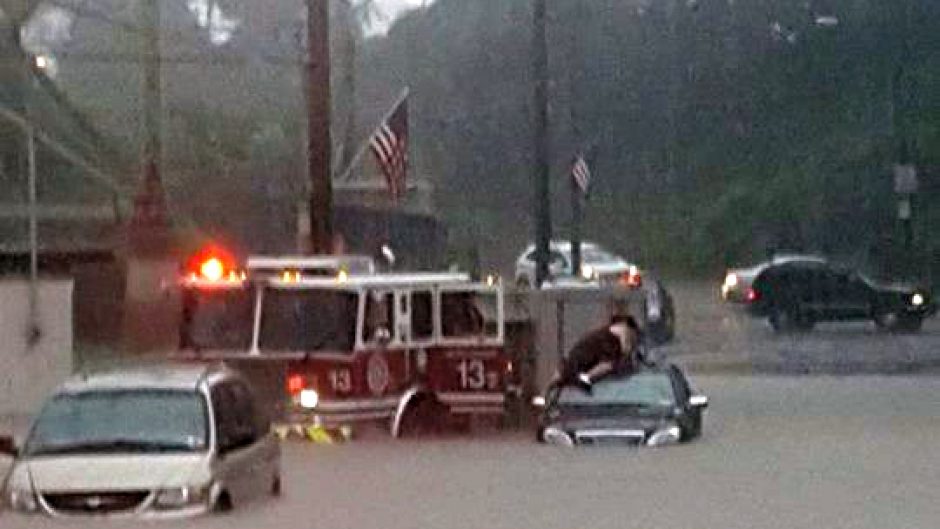
PWSA’s presentation calls out two previous floods in The Run: one 25-year event in 2011 and one 75-year event in 2009. It does not mention other events, such as a 2019 flood that included higher elevations in the neighborhood and a 2016 flood that trapped a resident and his son on the roof of their car.

Run residents have asked the PWSA Board to create a model for the Four Mile Run Stormwater Improvement project that excludes the controversial Mon-Oakland Connector (MOC) road through Schenley Park. MOC opponents contend that the MOC—a development project designed to lure corporations to Hazelwood Green—should not take precedence over the stormwater project. The core project in Schenley Park has long been considered “technically challenging” even without incorporating a new road.

Department of Mobility and Infrastructure (DOMI) director Karina Ricks commented, “We firmly support [PWSA’s] decision to take the time needed to ensure the massive stormwater investment we are making is the right one to best address the stormwater impacts that have affected The Run for so many years. The Mon-Oakland project will proceed concurrent with the PWSA green infrastructure project, thus our timeline is adjusted accordingly as well.”

Asked whether the PWSA has created a model without MOC or intends to do so, PWSA acting senior manager of public affairs Rebecca Zito responded, “The mobility project is a planned project and our model has taken into consideration that it would be constructed. Not including it would set false expectations and provide an unrealistic assessment for advancing the stormwater project. We appreciate that residents from the Run took the time to address the Board in March about this project. The Board heard your request to commission a model for the stormwater project without the mobility corridor project, unfortunately, we were not directed to do so.”

Five of PWSA’s six current board members were nominated by Mayor Peduto, a longtime proponent of MOC who faces an estimated $150+ million budget shortfall this year because of COVID-19. In contrast to PWSA’s stormwater project, which addresses a clear public safety issue and will be financed by the PWSA itself, the City-funded MOC project demonstrably fails to benefit residents in the neighborhoods it affects. By all appearances, Mr. Peduto’s priorities are the only reason the PWSA would view cancelation of the MOC as “an unrealistic assessment.” 

Contact the PWSA

412-255-2423
www.pgh2o.com/report-an-issue

Run Residents to PWSA Board: Create Model for Stormwater Plan Without MOC

On March 27, 2020, the Board of the Pittsburgh Water and Sewer Authority (PWSA) convened its monthly board meeting via telephone conference line. The Board received comments from several residents of The Run, the neighborhood most directly affected by the PWSA’s 4-Mile Run Stormwater Improvement Plan. They asked the Board to create a model for the project that excludes the controversial Mon-Oakland Connector (MOC) road through Schenley Park.

PWSA Chief of Program Management Alex Scuilli has stated on the record that no such models currently exist. MOC opponents have long contended that the MOC—a development project designed to lure corporations to Hazelwood Green—should not take precedence over the stormwater project, which addresses severe flooding in The Run as well as an EPA mandate to separate stormwater from sewage.

Despite its importance to public safety, the stormwater project is not expected to fix the flooding but only lessen it. Right-to-Know documents show Pittsburgh mayor Bill Peduto’s chief of staff Dan Gilman admonishing the PWSA to “improve the messaging on this issue” to adjust residents’ expectations. The vast majority of runoff that floods The Run comes from Greenfield—not Schenley Park, where funding for the stormwater project has been directed. Yet the project was originally pitched to residents as a way to address the flooding issue. The “messaging” changed in early 2019—well into the engineering process. The core project in Schenley Park has long been considered “technically challenging” even without incorporating a new road.

It seems likely the $41 million stormwater project could be more effective if it weren’t required to accommodate the MOC. Multiple experts have told residents of affected neighborhoods that the MOC could hinder flood control. Recently, Pittsburghers for Public Transit worked with analysts to complete a cost-benefit study of expanded public transit versus MOC shuttles in affected neighborhoods—but some costs of the MOC fall outside the scope of that study, including harm to the stormwater project’s effectiveness and to Schenley Park itself. These costs must be examined at least as carefully as the costs of inefficient shuttle service.

There is a clear public need for the PWSA’s stormwater project, and a clear lack of need for the MOC. The MOC benefits developers, not residents, and exemplifies the “non-essential construction” Governor Wolf has halted during the COVID-19 crisis. It is more prudent than ever to develop alternative plans.

Contact the PWSA

412-255-2423
www.pgh2o.com/report-an-issue

This Is Our Flooding Problem

Since last year, the PWSA has had $41 million in funding to fix an urgent public safety issue in the heart of Pittsburgh. Please call 412-255-2423 to ask them, “What’s the holdup?”

As you watch the video above, imagine that Four Mile Run is your neighborhood. In a way, it is.

Those of us who live here see “The Run” as unique, but it has the basics that most neighborhoods share: houses, sidewalks churches, businesses—and a community of people. Imagine these are your streets and homes filling with water, your neighbors becoming trapped on top of their car, your children at risk of drowning.

They are.

If you live in Pittsburgh, you’ve likely traveled over The Run on the Parkway East. You may frequent or live in the better-known neighborhoods above us that get this water first—and more and more of this water ends up in The Run as unchecked development covers acres of land with impervious surfaces like asphalt.

As the flooding steadily worsened over decades, your neighbors were told time and time again that our city lacked funds to fix it. So it was a big deal when PWSA secured the $41 million earmarked for the problem. Now, even with funding finally in place, more than a year has passed and work has not started on this important and necessary project.

Why so much foot-dragging? Unfortunately, there is more to the story—and the details are dirtier than the sewage in our basements.

Please call the PWSA at 412-255-2423 to demand they fix this urgent public safety issue using green solutions.